Step Into 1066: What Happens When History Stops Being a Subject and Starts Becoming an Adventure
There is a moment in every great lesson when something changes.
The room becomes quieter. Eyes lift from the tables. Conversations stop. Curiosity takes over.
It is the moment when learning becomes something more than information.
For many children in Key Stage 2 and Key Stage 3, history is introduced through textbooks, timelines and carefully structured lessons. These are all important, but even the best classroom resources can only take pupils so far. Reading about history is one thing. Feeling part of it is something entirely different.
Imagine walking into your school hall expecting an ordinary history lesson.
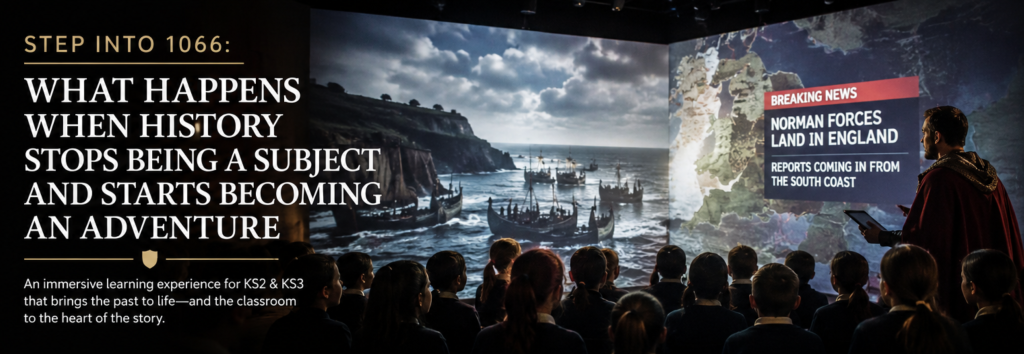
Instead, the lights dim.
A giant medieval map appears across the wall. A news bulletin interrupts the silence. Reports are arriving from the south coast. Ships have been spotted crossing the English Channel. William, Duke of Normandy, has landed.
Suddenly, 1066 is no longer a date to memorise.
It has become today's breaking news.
Children are no longer simply learning about the past—they are standing in the middle of it.
More Than Watching
One of the greatest misconceptions about immersive learning is that it is simply theatre performed in front of an audience.
True immersion goes much further.
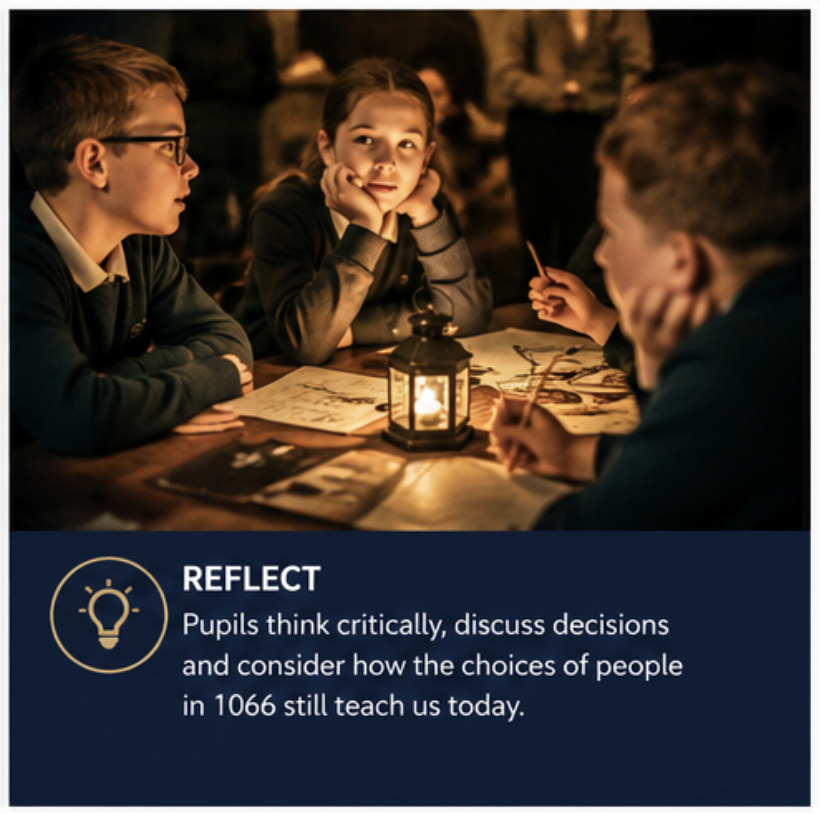
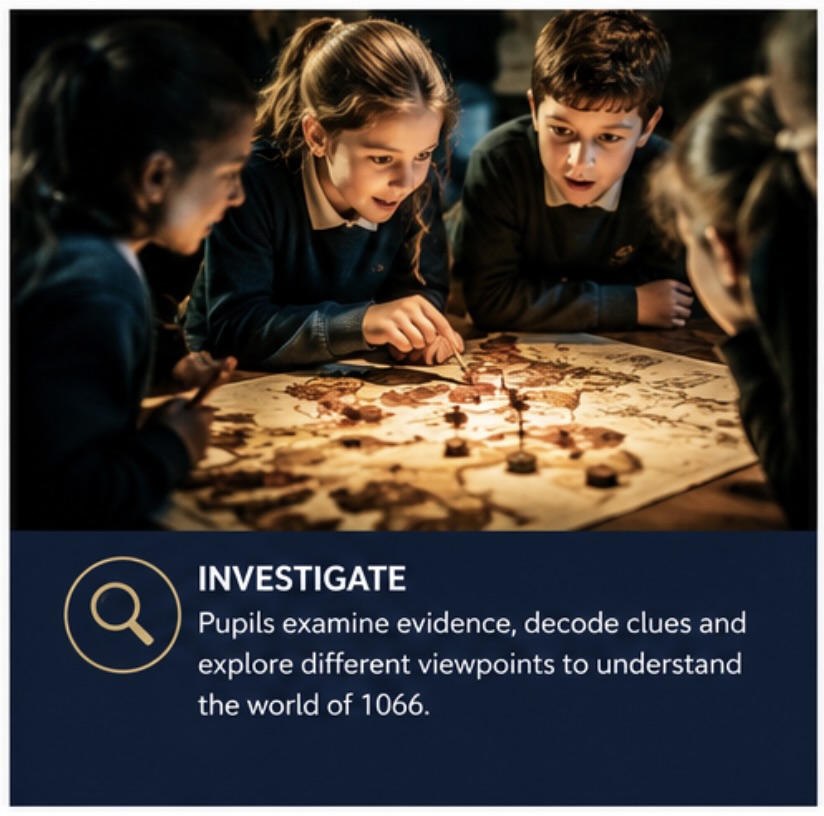
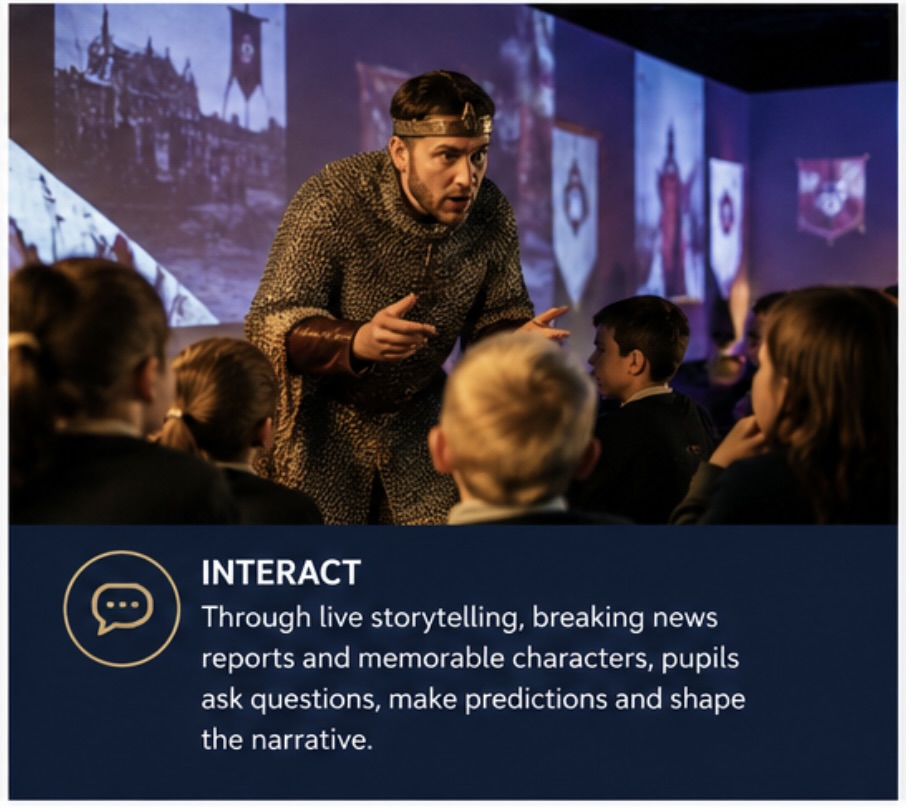
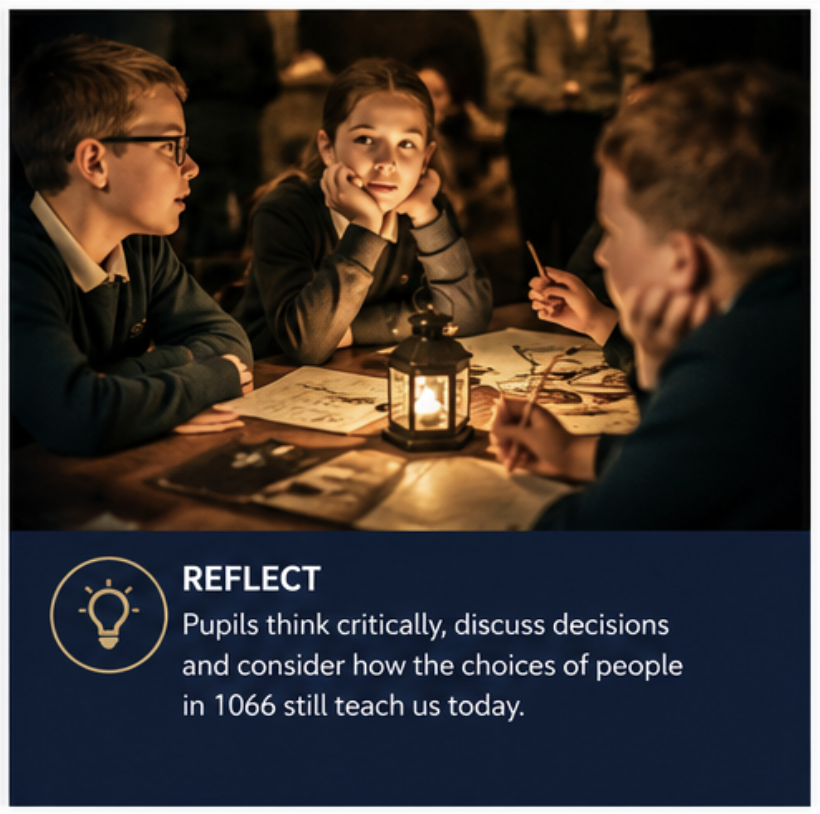
Instead of sitting back, pupils become active participants. They listen carefully to eyewitness accounts. They examine evidence. They discuss possibilities with classmates. They answer questions, make predictions and consider the difficult decisions facing people who had no idea how history would unfold.
Rather than asking, "What happened next?" they begin asking, "What would I have done?"
That shift changes everything.
History stops being a collection of facts and becomes a series of human choices made under pressure, often with incomplete information.
Why 1066 Still Captivates Young Minds
Nearly one thousand years later, the events of 1066 continue to capture our imagination.
Not simply because of the famous battle at Hastings, but because the story contains everything that makes great storytelling timeless: ambition, uncertainty, courage, rivalry, leadership and consequence.
King Harold II had already fought one major battle before turning south to face William. William himself could not know whether his invasion would succeed or fail. Every decision carried enormous risk, and every hour brought new uncertainty.
When pupils experience these events as they unfold rather than reading the ending first, they begin to appreciate history in a completely different way.
The people involved become real.
The choices become meaningful.
The consequences become unforgettable.
Learning That Lasts Beyond the Lesson
Teachers often speak about the challenge of helping knowledge "stick."
Children can remember dates for a test, yet forget them weeks later.
Experiences are different.
Most adults can vividly recall educational moments that surprised them, challenged them or made them feel something. Perhaps it was handling an ancient artefact, visiting a castle, performing in a school production or carrying out a memorable science experiment.
These moments stay with us because they engage more than memory alone. They involve curiosity, discussion, emotion and participation.
Immersive learning aims to create those kinds of moments.
When pupils actively engage with historical events, they build connections that extend beyond remembering names and dates. They begin developing skills that are valuable across every subject, including communication, teamwork, observation, questioning and critical thinking.
Supporting the Curriculum Through Experience
For schools, immersive experiences should never replace excellent classroom teaching.
They should enhance it.
For both KS2 and KS3 pupils, curriculum-linked experiences can provide valuable context before a topic begins, deepen understanding during a unit of work or reinforce learning once key concepts have been introduced.
A memorable experience often gives pupils a framework into which later learning naturally fits.
Instead of recalling isolated facts, they remember the story behind them.
Curiosity Is the Real Goal
Perhaps the greatest success of any educational experience is not measured by what happens during the session itself.
It is measured by what happens afterwards.
The questions pupils continue asking.
The conversations they have at home.
The books they decide to borrow from the library.
The documentaries they choose to watch.
The independent research they begin because they genuinely want to know more.
Curiosity has always been one of education's greatest achievements.
When children become curious, learning continues long after the lesson has ended.
Looking Back to Move Forward
History has never simply been about the past.
It helps us understand leadership, decision-making, resilience, conflict, innovation and the lives of ordinary people living through extraordinary events.
When pupils experience these stories rather than simply reading about them, history becomes something alive, meaningful and deeply human.
Perhaps that is why nearly a thousand years after the Norman Conquest, children still find themselves asking the same questions that people asked in 1066.
What happened?
Why did it happen?
And what might I have done if I had been there?
At The Immersium, we believe those are exactly the kinds of questions that great education should inspire.